Boosting Performance in Business Central with SetAutoCalcFields

In today’s fast-paced business environments, performance optimization is not a luxury — it’s a necessity. Whether you’re building custom reports, extending pages, or writing integration APIs in Microsoft Dynamics 365 Business Central, slow operations can frustrate users and strain resources.

One simple but powerful technique to improve performance is using the SetAutoCalcFields method.

Why FlowFields Matter for Performance

In Business Central, FlowFields are virtual fields calculated on the fly, not stored physically in the database. Examples include:

  • Inventory on Item
  • Balance on Customer

When you retrieve a record, FlowFields are not calculated automatically unless you explicitly call CalcFields().

Manually calculating FlowFields for every record during loops, leading to multiple SQL queries — one for each record — causing heavy load and slower performance.

SetAutoCalcFields solves this by batch-calculating FlowFields along with the record fetch.
Instead of running one query per record, it combines the calculation in a single optimized query.

Imagine fetching 1,000 customers and displaying their balances without SetAutoCalcfields:

CustomerRec.FindSet();
repeat
    CustomerRec.CalcFields(CustomerRec.Balance); // Triggers a DB call every time!
    DisplayBalance(CustomerRec."No.", CustomerRec.Balance);
until CustomerRec.Next() = 0;

Result:
  • 1 SQL query to get Customers
  • + 1,000 SQL queries for Balances

With SetAutoCalcFields:

CustomerRec.SetAutoCalcFields(CustomerRec.Balance);
CustomerRec.FindSet();
repeat
    DisplayBalance(CustomerRec."No.", CustomerRec.Balance);
until CustomerRec.Next() = 0;

Result:
  • 1 SQL query to get Customers and Balances together

Benefits of Using SetAutoCalcFields

  • Improved Page Load Times: By deferring calculations, pages with numerous records and calculated fields will load significantly faster.
  • Faster Report Generation: Reports that rely on calculated fields will be generated more quickly as the calculations are performed only when the field’s value is actually needed for display or processing.
  • Reduced Database Load: Fewer automatic calculations translate to fewer database queries, reducing the overall load on your Business Central database.
  • Enhanced User Experience: Snappier performance leads to a more responsive and enjoyable user experience.

Best Practices for Performance Gains

To maximize the benefits of SetAutoCalcFields:

  • Only specify necessary FlowFields:
    Don’t auto-calculate every FlowField — focus on what your process needs.
  • Use it before data retrieval:
    Call SetAutoCalcFields before FindSet(), FindFirst(), or FindLast()
  • Avoid unnecessary recalculations:
    Once FlowFields are set to auto-calculate, do not manually call CalcFields() again for the same fields.
  • Monitor heavy FlowFields:
    Some FlowFields (e.g., Inventory) involve complex sums across tables — only auto-calculate when really needed.
  • Profile your code:
    Use Performance Profiler to measure improvements.

Using SetAutoCalcFields properly can lead to dramatic performance improvements in Business Central.
By reducing SQL traffic, simplifying code, and batch-fetching FlowFields intelligently, you can create faster, cleaner, and more scalable applications.

A small change in your coding habits can create a big impact for your users.

Hope this will help..
FieldRef.IsOptimizedForTextSearch() Method in Business Central 2025 Wave 1

With the release of Business Central 2025 Wave 1, Microsoft continues to empower developers with more control and insights into the performance and behavior of their extensions. Among the new additions is the method FieldRef.IsOptimizedForTextSearch(), designed to help developers make more performance-conscious decisions when implementing search functionalities.

💡 What is FieldRef.IsOptimizedForTextSearch()?

FieldRef.IsOptimizedForTextSearch() is a method that returns a Boolean value indicating whether a particular field in a table is optimized for text search.

It is a method on the FieldRef data type, which is used in AL code to dynamically refer to fields of records, especially in scenarios involving field iteration, metadata handling, or dynamic filters.

✅ Syntax:

Boolean := FieldRef.IsOptimizedForTextSearch();

⚙️ How to Optimize a Field for Text Search

While IsOptimizedForTextSearch() only checks if a field is optimized, setting it up is done via the table metadata or through the table schema in AL.

To mark a field for text search:

field(10; Description; Text[100])
{
Caption = 'Description';
DataClassification = ToBeClassified;
OptimizeForTextSearch = true;
}

Setting OptimizeForTextSearch = true; enables text search optimization (depending on SQL backend settings as well for on-premise).

Lets see how we can utlize above method to check optimize search

var
    MyRecordRef: RecordRef;
    MyFieldRef: FieldRef;
    IsOptimized: Boolean;
begin
    MyRecordRef.Open(Database::Customer);
    if MyRecordRef.FindSet() then begin
        MyFieldRef := MyRecordRef.Field(Name); // Let's check the "Name" field
        IsOptimized := MyFieldRef.IsOptimizedForTextSearch();

        if IsOptimized then
            Message('The "%1" field in the Customer table is optimized for text search.', MyFieldRef.Name())
        else
            Message('The "%1" field in the Customer table is NOT optimized for text search.', MyFieldRef.Name());
    end;
    MyRecordRef.Close();
end;

To be optimized for full-text search, a field typically needs:

  • A Text or Code data type.
  • An active index that supports full-text search (defined in the table metadata or via table extensions).
  • Proper settings in SQL Server or Azure SQL (if full-text search is enabled).

The FieldRef.IsOptimizedForTextSearch() method is a small but powerful tool in the AL developer’s toolkit. Whether you’re designing smarter search UIs or optimizing performance in large datasets, this method gives you the metadata visibility to make informed choices.

By leveraging this feature, you can:

  • Improve app performance
  • Avoid slow queries
  • Create better user experiences

Stay tuned for more..

Generate launch.json from the Web Client in Business Central – Wave 1 2025

With the 2025 Wave 1 release of Microsoft Dynamics 365 Business Central, developers get a significant productivity boost: the ability to generate a launch.json file directly from the Web Client! 🎉 This is a feature that eliminates the need to manually configure environment settings in Visual Studio Code (VS Code), especially useful when working across multiple environments or containers.

💡 What is launch.json?

In AL development for Business Central, the launch.json file defines how your AL project connects to your Business Central environment. It includes settings like:

{
  "name": "Your Environment",
  "type": "al",
  "request": "launch",
  "server": "https://your-environment-url",
  "serverInstance": "BC",
  "authentication": "UserPassword",
  "tenant": "your-tenant-id"
}

You can now generate the launch.json configuration directly from the Web Client using just a few clicks. No more copying URLs, figuring out authentication types, or guessing server details.

🔧 Steps to Generate:

  1. Log into your Business Central Web Client.
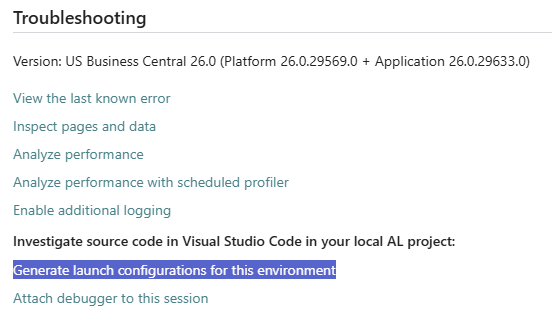
  2. Navigate to the Help & Support page (? page=134).
  3. Scroll down to the Troubleshooting section.
  4. Look for the new Download launch.json button (or similar option).
  5. Click it – a launch.json file will be downloaded, pre-filled with your current environment’s configuration.

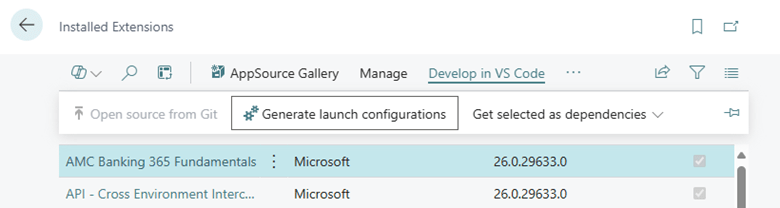
Second option will be navigate Installed extensions and download launch.json

The introduction of the launch.json generation feature in the Business Central Wave 1 2025 web client is a welcome addition for AL developers. It promises to streamline the initial setup process, reduce configuration errors, and enhance overall development efficiency.

Stay tuned fore more.

Business Central 2025 Wave 1 (BC26) – SetAutoCalcFields Method on RecordRef

Microsoft Dynamics 365 Business Central 2025 Wave 1 (version 26) introduces several enhancements to developer productivity and platform capabilities. One of the notable changes for AL developers is the new SetAutoCalcFields method added to the RecordRef data type.

This method brings the power of calculated flow fields to the RecordRef context, which previously lacked a built-in way to pre-calculate flow fields without manually invoking CALCFIELDS. Let’s explore what this update means, how it works, and how to use it effectively.

🧠 What is SetAutoCalcFields?

The SetAutoCalcFields method allows developers to specify which flow fields (calculated fields) should be automatically calculated when retrieving a record using the RecordRef data type.

This mimics the behavior of the SetAutoCalcFields method already available on the Record data type, extending it to scenarios where developers work with dynamic tables using RecordRef.

📘 Syntax:

RecordRef.SetAutoCalcFields(Field1, Field2, ...)

🛠️ Example

procedure DemoSetAutoCalcFields()
var
    RecRef: RecordRef;
    FieldRef: FieldRef;
    FieldRefAmount: FieldRef;
begin
    // Open the "Customer" table dynamically
    RecRef.Open(Database::Customer);

    // Get reference to the "Balance" flow field (Field No. = 21 in Customer)
    FieldRefAmount := RecRef.Field(21); 

    // Set the flow field to auto-calculate
    RecRef.SetAutoCalcFields(FieldRefAmount);

    // Find a record
    if RecRef.FindFirst() then begin
        // Now the "Balance" field will be auto-calculated
        Message('Customer Balance: %1', FieldRefAmount.Value);
    end;

    RecRef.Close();
end;

The introduction of the SetAutoCalcFields method on the RecordRef data type in Business Central 2025 Wave 1 is a welcome enhancement for developers. It provides a more efficient and streamlined way to work with AutoCalcFields when using RecordRef, leading to improved application performance and cleaner, more maintainable code.

Stay tuned for more.

File.ViewFromStream in AL: Display Text Directly from Stream

Microsoft Dynamics 365 Business Central 2025 Wave 1 continues to improve its developer experience with handy new features. One of the exciting additions in this release is the File.ViewFromStream method — a simple yet powerful function that enhances how developers interact with files stored in memory.

In the current versions of Business Central, when you need to view an attached document, a report output, or an incoming file, the typical process involves downloading the file first and then opening it with an external application. This can be time-consuming, especially when dealing with multiple files or when you simply need a quick glance at the content. Switching between applications disrupts your workflow and can feel inefficient.

📘 What is File.ViewFromStream?

The new method File.ViewFromStream(Stream: InStream,Text[,Boolean]) enables developers to open or preview a file directly from a stream, without having to save it to a temporary physical file.

This is a major convenience when working with files generated on the fly — such as PDFs, Excel files, or text reports — especially in scenarios where users just need to view or download the file rather than save it on the server.

Syntax

[Ok := ]  File.ViewFromStream(InStream: InStream, FileName: Text [, AllowDownloadAndPrint: Boolean])

🛠 Example:

procedure ShowGeneratedReport()
var
    TempBlob: Codeunit "Temp Blob";
    OutStream: OutStream;
    InStream: InStream;
    ReportContent: Text;
begin
    ReportContent := 'Hello from AL!' + Format(CurrentDateTime) + '\nThis is a preview of your text report.';

    TempBlob.CreateOutStream(OutStream);
    OutStream.WriteText(ReportContent);

    TempBlob.CreateInStream(InStream);
    File.ViewFromStream(InStream, 'ReportPreview.txt', true);
end;

💼 Use Cases

Here are some scenarios where ViewFromStream can be a game-changer:

  • Previewing customer invoices or sales reports generated on-demand.
  • Opening files attached in workflow approvals.
  • On-the-fly document generation in extensions or apps.

The File.ViewFromStream method offers a powerful and user-friendly way to present stream content directly within Dynamics 365 Business Central. The File.ViewFromStream method is a lightweight, client-friendly way to present text content on the fly in Business Central.

Stay tuned for more.

Embedding Powerful UI with UserControlHost PageType in Business Central

With the release of Business Central 2025 Wave 1, new page type UserControlHost is introduced which enables embedding custom JavaScript-based controls into the Business Central web client.

🔍 What is UserControlHost?

The UserControlHost page type allows you to embed custom client-side controls—typically written in JavaScript—inside the Business Central web client using the ControlAddIn object.These controls are built with web technologies—JavaScript, HTML, and CSS—and provide flexibility far beyond standard AL UI elements.

Think of UserControlHost as a “wrapper” that renders client-side controls defined via the ControlAddIn object.

You might consider using UserControlHost for:

  • Advanced data visualizations (charts, graphs, maps)
  • Dynamic dashboards or interactive UI widgets

🧱 How to use

To use the UserControlHost, you need two key components:

  1. A Control Add-In (ControlAddIn)
  2. A Page with PageType = UserControlHost
  1. Create the ControlAddIn
controladdin "MyWave2025Control"
{
    Scripts = 'scripts/chart.js', 'scripts/mycontrol.js';
    StartupScript = 'scripts/init.js';
    StyleSheets = 'styles/mycontrol.css';

    RequestedHeight = 400;
    RequestedWidth = 600;

    AutoAdjustHeight = true;
    AutoAdjustWidth = true;

    Events = OnItemSelected(text);
    Methods = LoadData(data: Text);
}

2) Create the UserControlHost Page

page 50200 "Dashboard Host"
{
    PageType = UserControlHost;
    ApplicationArea = All;

    layout
    {
        area(content)
        {
            usercontrol(MyCustomChart; "MyWave2025Control")
            {
                ApplicationArea = All;
            }
        }
    }

    trigger OnOpenPage()
    begin
        CurrPage.MyCustomChart.LoadData('{"region": "Thailand"}');
    end;

    trigger OnControlReady()
    begin
        Message('Custom Control is ready!');
    end;
}

The UserControlHost page type, especially with Wave 1 2025 enhancements, is the go-to choice for scenarios where traditional AL UI just won’t cut it. Whether you’re building modern dashboards, embedding custom charts, or creating interactive widgets

Using the New IncStr Overload in Business Central AL

With recent updates to AL language in Microsoft Dynamics 365 Business Central, developers now have more flexibility when working with strings containing numeric suffixes — thanks to the new overload of the IncStr method.

If you’ve ever had to increment a string with a number at the end (e.g., “INV001” to “INV002”), you’ve probably used IncStr. But until recently, IncStr only allowed an increment of +1.

Let’s explore how the new overload changes that.

🆕 What’s New in IncStr?

Traditionally, IncStr was used like this:

NewString := IncStr('INV001');  // Result: 'INV002'

Now, with the new overload, you can specify how much to increment by:

NewString := IncStr('INV001', 5);  // Result: 'INV006'

✅ Syntax:

IncStr(Value: String, IncrementBy: Integer): String

This enhancement is particularly useful in scenarios like:

  • Batch processing: Skipping ranges (e.g., test IDs, invoice numbers)
  • Custom logic: Implementing non-sequential numbering patterns
  • Looping identifiers: Where the next string isn’t always +1

⚙️ Example

LastCode := IncStr(LastCode, 5); // Jump by 5 in one go

🚧 Cases to Consider

  • It only increments the last numeric section of the string.
  • It respects the original number of digits (e.g., padding).
  • If there’s no number, it defaults to 1 and appends it.

IncStr('ABC', 3);  // Result: 'ABC3'

The new IncStr overload is a small change with big impact — making it easier to handle advanced string number incrementing without tedious code.

Stay Tuned for more.

Implicit Record and Record Ref Conversion in Business Central AL

When working with Microsoft Dynamics 365 Business Central, one of the most powerful capabilities is the dynamic handling of data using RecordRef. However, as a developer, you may have run into scenarios where you need to switch between the strongly typed Record and the flexible RecordRef—and wondered if there’s a clean way to do it.

Good news: Business Central now supports implicit conversion between Record and RecordRef

📘 Understanding the Core Types:

Before exploring the implicit conversion, it’s crucial to understand the distinct roles of Record and RecordRef:

  • Record: A strongly-typed variable that represents a specific table in the Business Central database. The compiler enforces type safety, ensuring that operations performed on a Record variable are valid for the defined table structure.
  • RecordRef: A more dynamic variable that provides a generic reference to any table in the Business Central database. It allows for runtime manipulation of table structures and data, often used in scenarios like generic data access, metadata exploration, and dynamic query building.

Implicit Conversion – What’s New?

With recent updates, AL now supports implicit conversion:

  • From a Record to a RecordRef
  • From a RecordRef back to a Record (if the types match)

This means cleaner, safer, and more readable code without the boilerplate RecordRef.GetTable() or RecordRef.SetTable().

🔍 Example: Record to RecordRef

procedure LogAnyRecord(rec: RecordRef)
begin
    Message('Table ID: %1', rec.Number);
end;

procedure RunLogging()
var
    customer: Record Customer;
begin
    customer.Get('10000');
    LogAnyRecord(customer); // Implicit conversion from Record to RecordRef
end;

No need for recRef.SetTable(customer) — it’s handled under the hood.

🔄 Example: RecordRef to Record

procedure GetCustomerName(recRef: RecordRef): Text
var
    customer: Record Customer;
begin
    customer := recRef; // Implicit conversion from RecordRef to Record
    exit(customer.Name);
end;

Implicit conversions between Record and RecordRef bring AL language making it easier to write dynamic yet type-safe code. While it’s a small feature on the surface, it greatly enhances developer productivity and code clarity.

Stay Tuned for more updates.

SessionInformation.Callstack() in Business Central

Introduced in Business Central Wave 1 2025 releases, the SessionInformation.Callstack() method is a powerful diagnostic tool that helps developers trace the current call stack within AL code. Whether you’re troubleshooting custom extensions, tracking errors, or building telemetry, this method can become your best friend.

What is the SessionInformation.Callstack() Method?

The SessionInformation.Callstack() method is a built-in function in AL that returns a text string representing the current call stack of the Business Central server session. Think of the call stack as a chronological list of the functions and procedures that have been called to reach the current point in your code.

Each entry in the call stack typically includes:

  • Object Type and Name: The type of object (e.g., Codeunit, Table, Page) and its name.
  • Function/Procedure Name: The specific function or procedure being executed.
  • Line Number: The line number within the function/procedure where the call originated.

📌 Syntax

var
    CallStackText: Text;
begin
    CallStackText := SessionInformation.Callstack();
end;

🧩 Why is the Call Stack Important?

Understanding the call stack is crucial for several reasons:

  • Debugging: When an error occurs, the call stack provides a trace of the execution path leading up to the error. This helps you pinpoint the exact location where the issue originated and understand the sequence of events that triggered it.
  • Error Handling: By capturing and logging the call stack when an error occurs, you can provide more context to administrators or support teams, making it easier to diagnose and resolve issues.
  • Code Understanding: Analyzing the call stack can help you understand the flow of execution in complex codebases, especially when working with unfamiliar code or trying to understand how different modules interact.

You can combine this with

  • ErrorInfo object (for AL error handling)
  • SessionInformation.UserId() or CompanyName() for full diagnostic logs
var
    CallStack: Text;
    ErrorData: ErrorInfo;
begin
    if not TryMyFunction() then begin
        GetLastError(ErrorData);
        LogToTable('Error: %1 - Stack: %2', ErrorData.Message, SessionInformation.Callstack());
    end;

SessionInformation.Callstack() is a small method with big potential. It’s the AL developer’s X-ray — revealing the path of execution in complex customizations or tangled logic.

Use it smartly, especially in:

  • Error handling routines
  • Long-running jobs
  • Telemetry and diagnostics pipelines

Stay Tuned for more updates

Calculate Values Only for Visible FlowFields in Business Central

FlowFields in Business Central are incredibly powerful, allowing you to dynamically calculate values based on related data. However, what happens when you have many FlowFields, but only a few are visible on a page? Calculating all of them can lead to unnecessary performance overhead. Business Central’s clever design allows you to optimize this process by calculating values only for visible FlowFields, significantly improving page load times and overall system responsiveness. Let’s delve into how this works and why it’s beneficial.

FlowFields retrieve data dynamically, often requiring complex calculations or lookups. While this provides real-time insights, it can also impact performance, especially when dealing with large datasets or numerous FlowFields.

Imagine a customer card page with dozens of FlowFields, but you only display a handful of them in the main view. Calculating all those FlowFields, even the hidden ones, wastes valuable resources. This is where Business Central’s “calculate only visible” feature comes into play.

The “Calculate Only Visible” Concept

Business Central intelligently determines which Flow Fields are currently visible on the page and only calculates those values. This optimization minimizes unnecessary computations, resulting in faster page loads and improved user experience.

Benefits of Calculating Only Visible FlowFields:

  • Improved Performance: Faster page load times, especially for pages with numerous FlowFields.
  • Enhanced User Experience: Smoother navigation and faster data retrieval.
  • Scalability: Allows you to design complex pages with many FlowFields without sacrificing performance.

Business Central’s runtime environment dynamically analyzes the page layout and determines which Flow Fields are currently displayed.

Business Central’s “calculate only visible FlowFields” feature is a powerful optimization that can significantly improve performance and user experience

Stay tuned for more.